








MUSCAT: Oman has embarked on its maiden journey into methane hydrates exploration, opening the door to what could become a transformative new source of energy for the Sultanate if commercially viable reserves are successfully unlocked in the years ahead.
An agreement to this effect was signed last week between the Ministry of Energy and Minerals and Victarens Global Energy for Block 83, an offshore concession extending into the Sea of Oman. Eng Salim bin Nasser Al Aufi, Minister of Energy and Minerals, inked the landmark pact with Kenan Issa, CEO of Victarens Global Energy.
Significantly, the agreement marks the first initiative of its kind in Oman focused on assessing the potential of methane hydrate production through non-conventional methods.
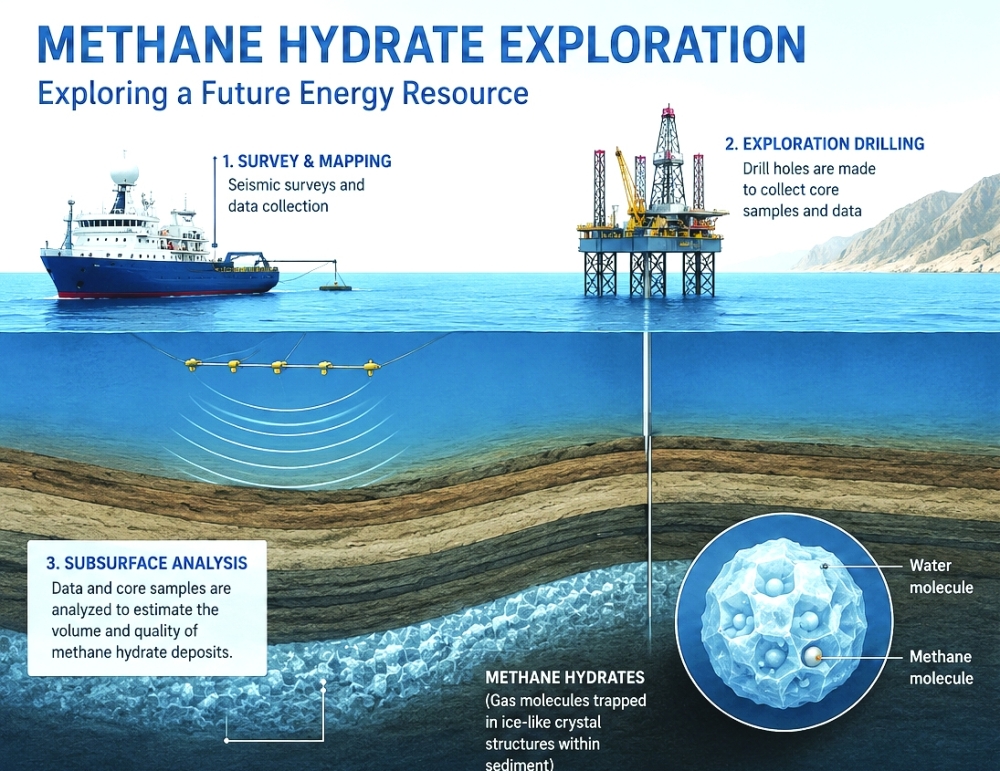
Methane hydrates — often referred to as “flammable ice” — are ice-like crystalline structures in which methane gas is trapped within water molecules under high-pressure and low-temperature conditions. Scientists estimate that global methane hydrate deposits may contain more energy than all conventional fossil fuel reserves combined, although commercial extraction remains technically complex and largely experimental worldwide.
According to the Ministry of Energy and Minerals’ upstream concession map, Block 83 — the subject of Oman’s maiden methane hydrates exploration agreement — is located offshore along the Qurayyat coast in the eastern part of the Sultanate. Its deep-water maritime setting is considered strategically significant for methane hydrate studies, as such resources are typically associated with high-pressure, low-temperature geological environments beneath the seabed.
For Oman, methane hydrates could present significant long-term strategic opportunities by strengthening future energy security, particularly if commercially viable offshore reserves are identified to supplement conventional natural gas supplies and meet growing domestic industrial and power demand. Extracted methane could also serve as an important feedstock for industries such as petrochemicals, fertilizers, LNG, and hydrogen production, while supporting the country’s energy transition objectives as a comparatively lower-emission fuel source.
In addition, the development of methane hydrate technologies could stimulate new investment in research, engineering, offshore services, and energy infrastructure in line with Oman Vision 2040. The Sultanate’s extensive Arabian Sea coastline and deep-water offshore areas may also offer promising geological potential for future exploration activities as global extraction technologies continue to advance.
Under the first phase of the project, Victarens Global Energy will conduct geological studies, analyse and reprocess existing geophysical data, and undertake new seismic surveys aimed at determining the size and thickness of methane hydrate formations within Block 83. The first phase is expected to require an investment of around $20 million.
Based on the findings, the project would advance to a second phase involving the installation of extraction systems and testing the feasibility of commercial production. This phase is projected to attract an additional investment of approximately $200 million.
Should methane hydrate production prove economically viable, negotiations would commence between the ministry and the company for a long-term development agreement covering commercial terms and profit-sharing arrangements, the ministry said.
Oman Observer is now on the WhatsApp channel. Click here


